
The Real Cost of Bad UX: Why 60% of B2B SaaS Users Quit in Week One
Bad UX rarely shows up as a single catastrophic failure. It accumulates in the friction of a confusing onboarding, a navigation structure no one can find their way around, and error messages that blame the user. By the time churn becomes visible in your metrics, the damage was done in the first seven days.
The Week One Problem
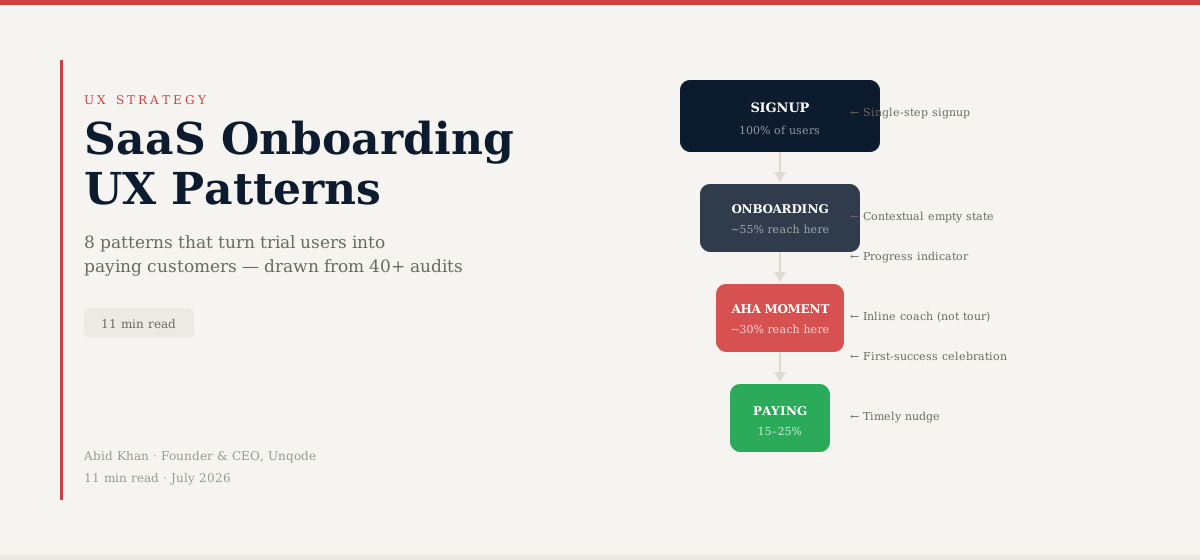
In B2B SaaS, the first seven days of a user's experience determine the trajectory of everything that follows. Multiple studies across the SaaS industry — including Intercom's product engagement benchmarks and data from over 1,500 SaaS companies tracked by ChartMogul — converge on a consistent finding: users who do not reach a meaningful "aha moment" within their first session or two are overwhelmingly likely to churn before their first invoice.
The 60% figure in this post's title comes from combined data across B2B SaaS products in the SMB and mid-market segments. It reflects the proportion of trial users who never activate a second core feature after signup. They log in, look around, feel uncertain about what to do, and quietly disappear. No cancellation email. No support ticket. They simply do not return.
The cost of this is not just lost revenue from those specific users. It is the compounding effect of acquisition spend wasted, the distorted product feedback loop that comes from only hearing from users who made it through, and the team time spent chasing growth at the top of the funnel while the bottom leaks.
The Hidden Costs That Do Not Appear in Your Dashboard
Support Volume
Forrester Research estimates that a single enterprise support interaction costs between $12 and $40 depending on channel and complexity. For SaaS products with poor UX, a significant proportion of support volume is generated by interface failures — users contacting support not because of a bug, but because they could not find a feature, could not understand an error message, or could not complete a workflow that should have been self-evident.
In a UX audit we ran for a B2B project management tool in 2024, we found that 38% of support tickets in a three-month period were directly traceable to four specific interface problems. All four were fixable without a product rebuild. The cost of those tickets over twelve months was substantially higher than the cost of the design intervention that resolved them.
Sales Cycle Lengthening
In enterprise and mid-market SaaS, poor UX in a trial or demo environment directly extends sales cycles. Prospects who cannot successfully self-serve through a product evaluation require additional sales touchpoints, deeper demos, and longer proof-of-concept periods. Each of those touchpoints has a cost in sales team time that does not appear in your UX budget but is absolutely a consequence of UX quality.
Expansion Revenue Loss
The highest-margin revenue in SaaS is expansion — existing customers buying more seats, upgrading plans, or activating additional modules. Expansion is a function of engagement. Users who have not fully adopted the core product do not expand. Products with poor UX produce users who use a narrow slice of functionality, never reach the value threshold that justifies expansion, and churn at renewal.
Poor UX does not just lose you the users who quit in week one. It caps the value you can extract from the users who stay — because they never go deep enough to need more.
The Onboarding Failure Patterns We See Most Often
Feature-Led Rather Than Outcome-Led Onboarding
The most common onboarding failure is a product tour that shows users where features are rather than helping them accomplish something meaningful. "Here is your dashboard. Here is your settings panel. Here is where you invite team members." This maps the geography of the product without giving the user a destination.
Outcome-led onboarding starts with the question: what is the first meaningful result this user can achieve? Then it creates a linear path to that result, removing every decision that is not essential to reaching it. Everything else can wait for session two.
Premature Complexity
Many B2B products surface their full feature set to new users immediately. The reasoning is usually "we want users to see everything they are paying for." The effect is paralysis. A new user confronted with a forty-item navigation menu, a dashboard full of empty state widgets, and a setup wizard that requires integration with three external tools before they can do anything useful will not feel empowered. They will feel overwhelmed and leave.
Progressive disclosure — revealing capability incrementally as users demonstrate readiness — is not dumbing down your product. It is respecting the cognitive reality of how humans learn new tools.
Error Messages That Blame
Error messages are UX moments that most teams treat as engineering problems. "Invalid input." "Request failed." "An unexpected error occurred." These messages tell the user they did something wrong without telling them what or how to fix it. They are trust-destroying micro-moments that accumulate into a general sense that the product is difficult and hostile.
Good error messages are written by someone who understands the user's mental model in that moment. They say what went wrong in plain language, why it matters, and — critically — what to do next. This is a content design problem. It costs almost nothing to fix and has an outsized effect on user confidence.
How to Measure UX Quality in Business Terms
The most effective way to make a business case for UX investment is to attach UX metrics to metrics leadership already tracks. This requires a bit of translation work.
- Time-to-first-value (TTFV): How long does it take a new user to complete their first meaningful action? This is a UX metric with a direct relationship to activation rate and trial conversion.
- Feature adoption depth: What percentage of users activate a second, third, or fourth core feature within thirty days? Low depth is a navigation and discoverability problem with a direct relationship to expansion revenue.
- Support ticket rate by cohort: Do users who onboarded in the last six months generate more or fewer tickets than older cohorts? Improvement here maps directly to support cost per customer.
- Week one return rate: Of users who log in on day one, what percentage return within seven days? This single metric is probably the clearest early signal of UX quality available to a SaaS business.
What Good Week-One UX Actually Looks Like
The products that consistently achieve high week-one retention share a common set of design principles, regardless of their category or complexity. They have a single, clear first action that delivers immediate visible value. They defer setup and configuration to after the user has experienced value, not before. They use progressive profiling to learn about the user over time rather than interrogating them during signup. And they have invested in the empty state — the experience of a new user looking at a product that has no data yet — as a primary design surface rather than an afterthought.
Investing in week-one UX is not a feature project. It is a revenue project. Every percentage point improvement in week-one return rate compounds through trial conversion, expansion revenue, and referral likelihood. The ROI of getting this right is as high as any investment a SaaS company can make, and it requires a fraction of the engineering resources of a new feature build.
Revenue Leak Calculator
Put a number on it — enter your monthly visitors, conversion rate, and average revenue per user. See your monthly UX revenue loss instantly.
Written by
Founder & CEO
Founder of Unqode. Fifteen years designing B2B SaaS, healthcare, and fintech products for teams across India, the UK, and North America.
View all articles
Want us to audit your product?
Book a free 30-minute call and we will tell you exactly what to fix first.
Book a free call