
How to Hire a UX Design Agency: 9 Questions That Weed Out the Wrong Ones Fast
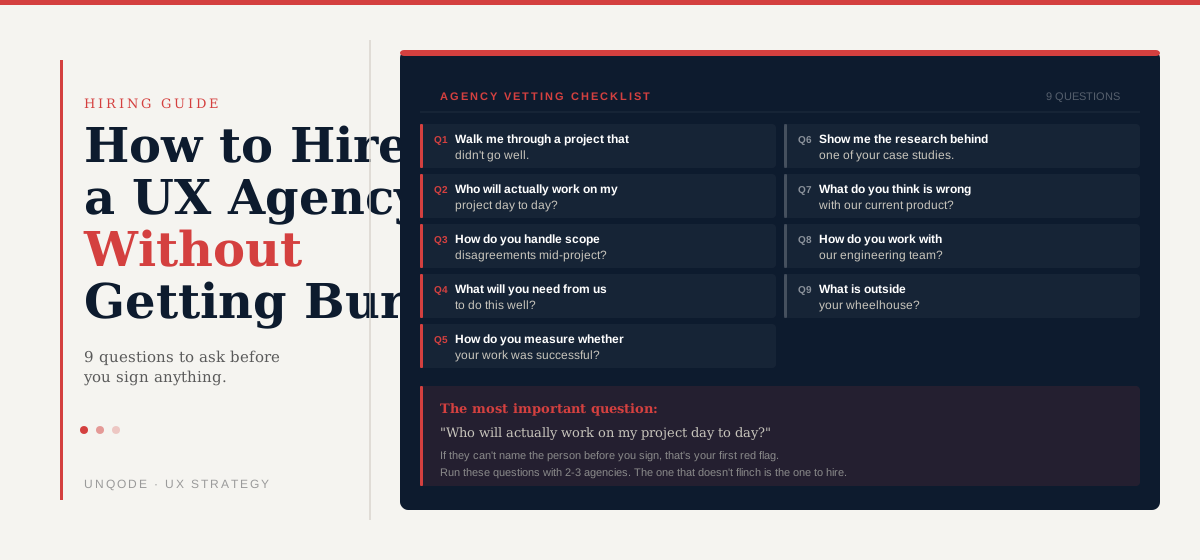
Most UX agency pitches look identical — polished decks, impressive logos, vague promises about 'user-centric design.' Asking the right nine questions in the first call will tell you more about an agency than their entire portfolio. Here is what to ask, and what the answers should sound like.
The Problem with Agency Pitches
Every UX agency pitches the same way. They show you a deck with a famous client logo on slide three. They talk about their "human-centred process." They use the word "empathy" four times. The slides are beautiful. The team seems sharp. You leave the call feeling good but knowing almost nothing useful about whether they can actually solve your specific problem.
I have been on both sides of this conversation for over fifteen years — pitching as an agency and watching my clients navigate pitches from competitors. The pitch format is optimised for looking credible, not for revealing competence. Most hiring decisions in this space are made on gut feel and visual impression, which is exactly how you end up three months in with a beautiful deliverable that your users cannot navigate.
The questions below are designed to break the pitch format and force a real conversation. Some of them will make agencies uncomfortable. That discomfort is informative.
Question 1: "Walk me through a project that did not go well."
Every agency has a portfolio of wins. The ones worth hiring have also learned from failures — and are honest enough to tell you about them.
A good answer names a specific project, explains what went wrong without blaming the client, identifies what the agency did differently as a result, and connects the lesson to their current process. A bad answer is a vague story about "challenges we overcame together" that ends with everything working out fine.
Agencies that cannot answer this question honestly are either very new (limited experience) or curating a version of themselves that does not match reality. Neither is what you want.
Question 2: "Who will actually work on my project day to day?"
This is the most important question on the list and the one clients ask least often. Large agencies in particular are structured so that the senior people pitch and the junior people deliver. You are buying access to the judgment and experience of the person in the room, and you may not get it.
A good answer gives you a name, a title, and the ability to speak directly to that person before you sign. A suspicious answer is anything that involves phrases like "our team," "the right resource for your needs," or a pivot back to talking about the agency's collective capabilities.
Ask to meet the person who will lead your project. If they cannot commit to who that is before the contract is signed, that is your first red flag.
Question 3: "How do you handle scope disagreements mid-project?"
Every project with a fixed scope eventually hits a moment where reality diverges from the brief. What a client needs turns out to be slightly different from what was specified. A user research finding changes the priority of a feature. A stakeholder introduces a new requirement two weeks in.
How an agency handles these moments reveals more about working with them than anything in their portfolio.
A good answer has a specific process: how they document scope changes, how they decide what is included versus billable, and how they communicate tradeoffs to the client in that moment. A bad answer is either defensive ("we manage scope very tightly") or vague ("we're flexible and collaborative").
You are not looking for an agency that never has scope discussions. You are looking for one that handles them with transparency and clear process rather than with surprise invoices.
Question 4: "What will you need from us to do this well?"
Good agencies know that they will fail without client input, access, and participation. The question exposes whether they understand this.
A good answer asks for specific things: access to users for research, analytics data with funnel visibility, time from a key stakeholder for decision-making, engineering availability for feasibility checks. A weak answer is "just give us a good brief and we'll take it from there."
If an agency does not ask much of you, they are either planning to make assumptions where they should be asking questions, or they are planning to deliver a generic solution that does not require your specific context. Neither produces good outcomes.
An agency that tells you they need nothing from you is planning to design for a product they have imagined, not the one you actually have.
Question 5: "How do you measure whether your work was successful?"
UX design is not decoration. It is supposed to move a metric — activation rate, conversion, task completion, retention, support ticket volume, something measurable. Agencies that cannot connect their work to business outcomes are delivering aesthetics, not design.
A good answer names specific metrics, explains how they define success before the project starts, and describes how they track outcomes after delivery. Bonus points if they mention checking in post-launch to see whether the expected impact materialised.
A red flag answer: "We measure success by client satisfaction." That is a measure of whether you liked working with them, not of whether the work did anything.
Question 6: "Show me the research that informed one of your case studies."
Portfolios show outputs. Ask about inputs.
Pick a case study from their portfolio and ask them to walk you through the research that preceded the design decisions. Who did they talk to? What did they find? How did a specific user insight connect to a specific design decision?
This question has no good fake answer. Either they did the research and can talk about it specifically, or the case study is a creative project dressed up as a UX project. You will know immediately which you are looking at.
Some agencies do excellent work without extensive upfront research — rapid design iterations, design system work, visual overhauls on well-understood products. That is legitimate. But they should be honest about it rather than retroactively framing every project as research-led.
Question 7: "What do you think is wrong with our current product?"
This one takes preparation on their end, which means they either did it or they did not. Ask it early in the pitch process — before the deck — so you can see who prepared.
A good answer is specific and prioritised. They looked at your product, identified real friction points, and have a point of view about what to fix first and why. It will probably be uncomfortable to hear. That is fine. That is what you are hiring them for.
A weak answer is general: "Your onboarding could be improved" or "The mobile experience has some opportunities." Every product has those. Specificity is the signal.
If an agency pitches you without having actually used your product, you have learned something important: they will apply a generic process to your specific problem and deliver a generic result.
Question 8: "How do you work with our engineering team?"
Design that cannot be built is expensive artwork. The best UX agencies treat engineering as a constraint to design within, not an obstacle to route around. They check feasibility during design, not after. They produce specifications that developers can actually interpret. And they are available during the build phase to answer questions — not just to throw files over the wall.
A good answer describes a collaborative process: regular check-ins with engineering during design, willingness to adjust designs based on implementation constraints, handoff documentation that includes interaction states and edge cases, and availability post-handoff for clarification.
A warning sign: agencies that talk only about Figma files as the delivery. A Figma file is a representation of a design, not a specification. If that is all they deliver, you will spend significant engineering time interpreting ambiguity — and the result will differ from what was designed.
Question 9: "What is outside your wheelhouse?"
Every agency has limits. The honest ones tell you what they are.
Full-service agencies that claim to do everything equally well are lying, or they are spreading thin. Strong specialist agencies know exactly what they are not — they refer out the work they cannot do well, and they tell you clearly if your project needs something they cannot provide.
A good answer to this question names specific things: "We do not do brand strategy," "We are not the right choice for a full native mobile build," "Our strongest work is B2B SaaS — we have done less in consumer e-commerce." That specificity is trustworthy. "We can handle everything you need" is not.
What to Do with the Answers
Run these questions across two or three agencies simultaneously. The goal is not to find an agency that answers every question perfectly — it is to find one whose answers, across the full set, demonstrate honest self-awareness, a real process, and the specific capability your project requires.
Weight question two heavily if you are engaging a larger agency. Weight question five heavily if your project has a specific business goal attached. Weight question six heavily if your product problem requires user research to solve.
And notice how agencies respond to being asked hard questions. A team that becomes defensive, pivots away, or answers in marketing language is showing you exactly what working with them will feel like when the project gets difficult. A team that engages directly, answers honestly, and pushes back on your assumptions where they disagree — that is who you want in the room when the hard decisions have to be made.
One More Thing: Agency vs. Freelancer
For many projects, a strong senior freelancer is the better choice over an agency. They are faster to engage, more flexible on scope, and you know exactly who is doing the work. The argument for an agency is: coordination across multiple specialists (researcher, designer, developer, writer), continuity if one person leaves, and institutional knowledge that survives individual departures.
If your project requires multiple skill sets in sequence — research, then UX design, then visual design, then frontend development — an agency that houses all of those is genuinely more efficient than assembling a freelancer team. If your project needs one senior designer for twelve weeks, a freelancer will almost certainly outperform an agency on value for money.
The nine questions above apply equally to both. The answers will just have different shapes.
AI Website Roast
Before you hire anyone, see what an AI finds wrong with your current site — 10 specific UX problems with severity ratings in 30 seconds.
Written by
Founder & CEO
Founder of Unqode. Fifteen years designing B2B SaaS, healthcare, and fintech products for teams across India, the UK, and North America.
View all articles
Want us to audit your product?
Book a free 30-minute call and we will tell you exactly what to fix first.
Book a free call